Why open source

A closed API is the fastest way to start, but it leaves four big decisions with the provider. Open-source models hand them back to you.

Who makes the call
Closed API Open source
Which model runs Whatever they serve The weights you chose
Where prompts go Their cloud Where you choose, even on‑prem
What it costs Their price list Your pick of provider or hardware
When it retires Their roadmap When you decide

The case for the move

What you gain

No forced deprecations

Most important

The version you validated keeps running until you decide to upgrade, not when a vendor retires it. No more re-running evals on someone else's schedule.

Own your models and data

Full sovereignty over both. Download the weights you validated and keep a copy no provider can pull.

Stronger privacy

Prompts that carry PII stay inside your VPC or on‑prem instead of crossing to a third party.

Cost you can control

Token factories are among the cheapest per token, and self-hosting breaks even once your volume is high enough.

No lock-in

OpenAI-compatible endpoints behind a gateway make the model a config choice, not a rewrite.

Expertise you own

Fine-tuned small models embed your domain knowledge, a competitive advantage a shared API can't give you.

Smaller footprint

A right-sized model uses less compute per request than a frontier model, which lowers both cost and carbon.

What you take on

No indemnification

Open-weight models ship without provider liability coverage for erroneous outputs.

You own the guardrails

Moderation, policy enforcement, and red-teaming are no longer bundled in.

Licenses need review

Apache 2.0 and MIT suit most commercial use; anything else goes past legal.

Someone has to run it

Self-hosting costs ops headcount as well as GPUs.

Find your path

You don't need every step to see the benefit. The guided triage asks each owner a few questions and turns the answers into a roadmap for your use cases. The full guide lays out all twelve steps.

Dataiku
0/12 steps complete

Why take this path

Moving to open-source models offers complete sovereignty over your models and data, better privacy, a smaller carbon footprint, and — most important — immunity from the deprecation timelines closed providers impose. Many organizations realize most of the benefit before the final step: integrating an open-source provider is often enough. Work through as far as the value justifies.

Phase I · AuditSteps 1–4 — inventory, evidence, and evaluation groundwork

Before a potentially long transition, get clear on your enterprise and system constraints. They define which open-source environments are available to you — for example, whether you may run non-U.S. open models.

  • Are you operating under import/export restrictions (e.g. U.S. trade law)?
  • Do you require compliance with sector regulations (e.g. healthcare laws)?
  • Do you require provider liability coverage against erroneous model outputs (as some firms obtain from OpenAI or Anthropic)? Open-weight models ship without indemnification.
  • Are you currently in compliance with your own requirements? If not — don't stop reading.
  • Where must data reside, and which certifications apply (SOC 2, HIPAA, GDPR)?
Tooling

Dataiku Govern Node. Policy, risk, and compliance registries that non-technical teams can use to assess requirements before a project or agent is built. Compliance needs can be pinned to new and existing projects and act as a deployment blocker where necessary.

Define your AI use cases precisely, focused on what you run today — the ecosystem moves too fast to design around future capabilities. Complex agent harnesses or simpler document extraction? If you can't answer confidently, start logging real traffic first.

  • What AI is being built across the enterprise — beyond the use cases you already run?
  • Which models, agents, tools, and workflows are you dependent on today?
  • Where are cost, risk, compliance, and resilience problems already emerging?
  • Which legacy analytics workflows are candidates for migration?
  • Which business process could become your first integrated agentic workforce?

Recommended tools for baseline tracking

Tooling

Dataiku. Capture prompts, responses, and token statistics natively in the platform's LLM Mesh — a central gateway that logs traffic, tracks cost across providers, and applies governance to every call. The Govern Node adds a central registry of all projects and models across the enterprise, tracking each use case against cost, value, and risk appetite.

Arize Phoenix (OTEL-native). Elastic License 2.0 (ELv2), source-available. Captures the exact prompt, response, token counts, latency, and any retrieval or tool steps for every request, and self-hosts via Docker Compose — keeping captured logs inside your own environment.

Template · Use-case definition
Use-case ID / name
—
Business owner
Stakeholders
Description
Business value
Current model
Provider
I/O format
Free text / JSON / multimodal
Reasoning intensity
Lookup · light · heavy · agentic
Tool calling
Y / N — which schema
Context length
Typical / max tokens
Latency need
Interactive < Xs / batch
Volume
Requests/day · tokens/day
Quality bar
Metric & how measured
Cost of error
Cosmetic · costly · regulated
Compliance
PII · PHI · residency · export
Samples
Link to logged examples

Cost baseline calculator

Capture today's spend per use case so you can run a true benefit analysis at the end. Adjust the inputs — totals update live.

Monthly inference cost · per use case
avg daily volume
Tokens / month
—
Cost / month
—
Cost / year
—

Run it once per use case and keep the annual figures together — that sum is today's spend. The hard part of the baseline isn't that number, though: it's the total cost of ownership once GPUs and people are priced in. That comparison lives in Step 8.

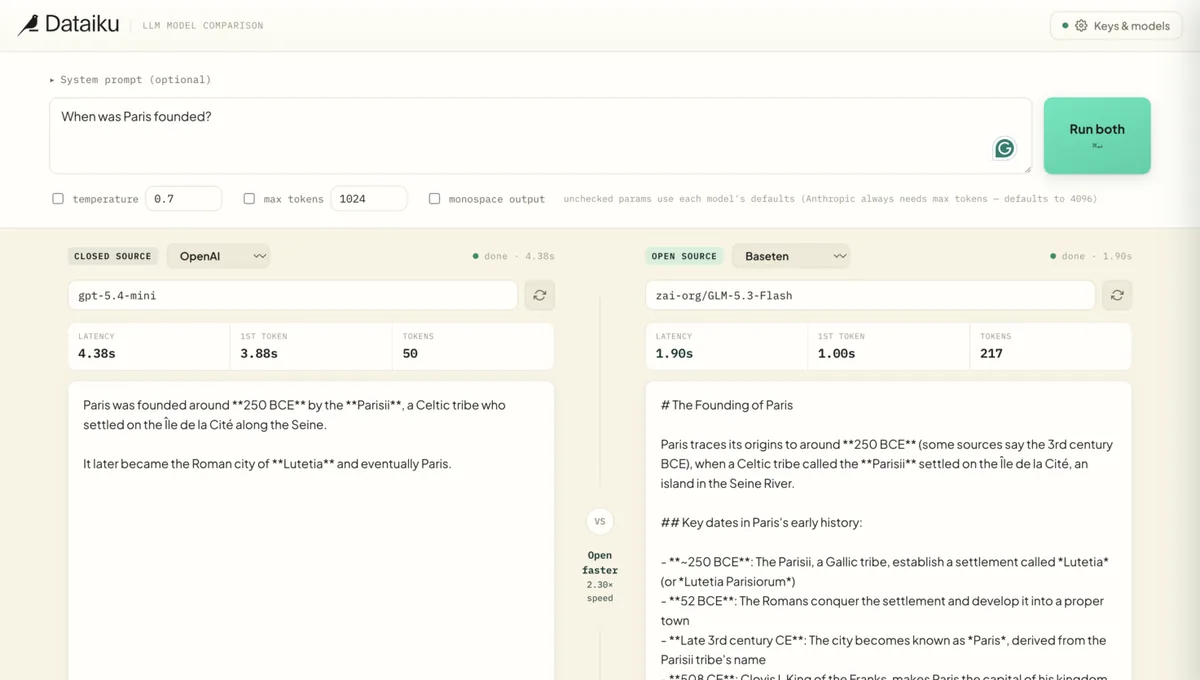
With requirements and use cases in hand, build confidence by grounding expectations in evidence. Replay the prompts you captured in Step 2 against open models side-by-side with your current closed model, and watch for meaningful degradation in the responses. To make that comparison easy, you can use a side-by-side arena such as this LLM arena.

The results show your organization the constraints of open models and give confidence the project will succeed. If you see major degradation, check for model-specific prompting fixes first. If prompting doesn't close the gap, the model may not handle that use case without problem-specific fine-tuning (see Step 10).

  • Which workloads should stay on frontier closed models?
  • Which should move to open-source, open-weight, or self-hosted models?
Caution · data handling

Run comparisons inside your own environment whenever the prompts carry production data. For regulated use cases those prompts can contain PII, and routing them through an external page undercuts the sovereignty you're migrating for.

Early results are seductive. LLMs are good at looking perfect when you've only scratched the surface, so don't be swayed. Defined metrics let you automate large-scale testing, find edge cases, and plan for failure — the absence of real evaluation is the single biggest risk to an AI project, and the most common cause of failure.

  • Which agents and workloads need monitoring and governance now — before any migration?
Recommended tooling

Dataiku. Evals as part of the managed platform: run evaluation recipes over your own datasets, compare candidate models side-by-side, and score outputs with built-in metrics and LLM-as-a-judge — reusing the prompts and traces you captured in Step 2 without leaving the platform.

promptfoo or DeepEval, wired into CI. promptfoo runs prompt/output comparisons and LLM-as-a-judge checks from simple config and is strong for red-teaming; DeepEval is "Pytest for LLMs" for unit-test-style assertions.

Public datasets by use case

If you lack your own labelled data, fall back on a public dataset matched to your primary use case:

Use case Suggested datasets Hugging Face
General knowledge / reasoning MMLU-Pro, GPQA MMLU-Pro, GPQA
Coding SWE-bench Verified, HumanEval, LiveCodeBench SWE-bench V., HumanEval, LiveCodeBench
Math GSM8K, MATH-500, AIME GSM8K, MATH-500, AIME
RAG / factual QA Natural Questions, HotpotQA, TriviaQA NQ, HotpotQA, TriviaQA
Summarization XSum, CNN/DailyMail (prefer domain data) XSum, CNN/DM
Instruction following IFEval IFEval
Agentic / tool use τ-bench, BFCL, GAIA τ-bench (repo), BFCL, GAIA
Long context RULER, needle-in-a-haystack RULER (repo)
Caution · contamination

Public benchmarks are often present in a model's training data, so scores on them flatter results. Use them only as a fallback, and weigh a held-out set drawn from your own logged traces (Step 2) far more heavily.

Phase II · Continuity planSteps 5–10 — models, providers, gateway, and serving

Verify the license before you build. Permissive licenses (Apache 2.0, MIT) suit most commercial use. For anything else, involve legal — terms can include revenue/user caps, deployment limits (e.g. Meta), or patent indemnification clauses (e.g. NVIDIA).

License Example models What it means for you
Apache 2.0 Qwen 3.x, Mistral Large 3 / Small 4, Gemma 4 Commercial use, fine-tuning, redistribution — no royalties or user caps. Safest default.
MIT DeepSeek V4, GLM-5 / 5.1, Kimi K2.x Same freedom as Apache; no explicit patent grant.
Custom · caps Llama 4 (Meta Community License) 700M-MAU clause and EU restrictions — legal review at scale or for EU deployment.
Custom · patent NVIDIA Nemotron (NVIDIA Open Model License) Review patent and indemnification clauses before shipping.
Non-commercial Cohere Aya / Command (CC-BY-NC) Cannot be used commercially without a separate license.
Unpublished MiniMax M3, some DeepSeek point releases Terms not yet clear (as of June 2026) — legal-review-required; don't build production on these yet.
Rule of thumb

Prioritizing flexibility? Apache 2.0 (Qwen, Mistral, Gemma) or MIT (DeepSeek, GLM) carry no usage caps, royalties, or geographic restrictions. For anything else, consult legal.

Tooling

Dataiku Govern. The LLM Vendor Solution consolidates which models legal, compliance, business, and engineering have approved — and under which requirements — and surfaces every project calling a given LLM, with usage approvals tracked per project.

Finally, download and securely store the weights (e.g. from Hugging Face). A local copy is your core risk mitigation — it guarantees business continuity if a provider discontinues service or pulls a model. Verify provenance and checksums before loading downloaded weights.

Replace your existing integrations with endpoints from a reputable open-source provider. They all expose OpenAI-compatible endpoints, so migrating is typically swapping the base URL, API key, and model ID — though you should still budget for prompt, tokenizer, and function-calling differences (see Step 3). It's rarely only a token swap.

Together AIAll-rounder: serverless, batch, dedicated, fine-tuning under one API.
Fireworks AIPerformance-oriented; fast inference plus fine-tuning and a broad catalog.
BasetenProduction control: your GPU, serving engine, autoscaling, private endpoints.
DeepInfraWidest current catalog, among the cheapest per token.
GroqRaw-speed specialist (custom LPUs) for real-time UX; narrower catalog.
Replicate / ModalPrototyping & bring-your-own-container deployments.
OpenRouterSingle API routing across providers; avoids lock-in at a small markup.
EU-hostedData residencyNebius, Scaleway, Mistral La Plateforme run inference inside the EU.

Don't wire applications directly to a single provider. Put a gateway in front so you can route, split, and fall back across models from one OpenAI-compatible interface — the abstraction that makes the rest of this migration safe.

Recommended tooling

LiteLLM. A unified, OpenAI-compatible gateway that splits traffic between open- and closed-source models, with automatic fallback, retries, rate limiting, per-key budgets, and centralized cost tracking. Your apps keep one interface while you move models behind it.

7.1 · Rollout & rollback

Introduce the open model progressively, with a gate at each stage and a defined way back.

Shadow mirror traffic, compare offline→Canary small live slice→% traffic ramp up

Set success gates (quality, latency, cost) between stages, and define rollback triggers up front: what threshold sends traffic back to the previous model, and who can pull the lever.

7.2 · Safety & guardrails

Open models generally ship without the sophisticated guardrails bundled into closed providers — the biggest single delta you inherit when you migrate. You now own moderation and policy enforcement.

  • Add input/output content safety (e.g. Llama Guard, ShieldGemma) at the gateway.
  • Enforce policy, format, and grounding with NeMo Guardrails or Guardrails AI.
  • Defend against prompt injection, and red-team before and after launch.

Keep tracking every request. Continuous monitoring surfaces new edge cases and lets you compare costs over time — both critical pillars of a durable transition. Reuse the evaluation tooling from Step 4 to keep the solution performant, reliable, and aligned with the business.

API vs self-hosting — total cost of ownership

Token price alone doesn't decide self-hosting; reserved GPUs and the people who run them do. This calculator compares a hosted provider against self-hosting at your volume, and finds the break-even point.

Hosted API vs self-hosted · monthly TCO
e.g. 6000 = 6B/mo
reserved 24/7
fraction of a person
Hosted / month
—
Self-host / month
—
Break-even volume
—
Self-host eff. $/M
—
—

For high-volume, critical workloads, self-hosting in your own environment is often optimal. It maximizes data privacy and gives full control over versioning and deprecation. Hosting inside your VPC also minimizes latency and keeps connectivity to the rest of your infrastructure secure.

  1. Provision reliable hardware. Use dedicated GPU instances; reserve them for production rather than relying on spot pricing, which can cause unexpected downtime.
  2. Go serverless for small models. For efficient models (typically < 12B params), serverless options like Cloud Run give zero idle cost and elastic scaling.
  3. Design for horizontal scalability. Plan for fluctuating traffic from the start; pick a serving stack (vLLM, TGI, SGLang) and plan quantization, batching, and autoscaling.

Common self-hosting providers to evaluate: Nebius, CoreWeave, Google Cloud, and AWS Bedrock.

To optimize performance and efficiency together, fine-tune smaller open models on domain-specific data. Beyond cost savings from running a specialized model, this embeds proprietary expertise directly into the model — a real competitive advantage. Exhaust cheaper levers first (prompting, few-shot, RAG).

Weigh the trade-offs

You take on full lifecycle management and hosting of these models (requires Step 9), and the fine-tuning process itself is a significant engineering investment.

Phase III · LeadershipSteps 11–12 — ownership, change management, and review

The technology is only half the transition. Document the new open setup and make the team self-sufficient on it.

  • Write a runbook for the new architecture: how to swap or upgrade a model endpoint behind the gateway.
  • Document evaluation, rollout/rollback, and guardrail procedures so they're repeatable.
  • Assign clear ownership for the gateway, serving stack, and on-call; train the teams that depend on it.

Close with a formal retrospective that goes beyond implementation detail and includes business stakeholders. Review unexpected failure modes, edge cases that emerged after deployment, and actual costs versus your baseline projections. Assess uptime and latency against your service-level objectives to confirm the new infrastructure meets the business.

The destination is control

The shift from closed to open source isn't a single event — it's a sequence toward greater autonomy and technical control. It asks for real commitment to understanding requirements, building internal trust, and running rigorous evaluation.

Done well, you gain more than sovereignty over your models and data. You position the organization to innovate faster, optimize infrastructure costs, and build more reliable AI aligned with long-term goals — a strategy that stays robust, independent, and adaptable to a fast-moving ecosystem.

Resources

Tools and initiatives from the open-source AI community that take this guide further. Each one links out; the step buttons open the part of the guide it supports.

Dataiku · Open source office

575 Lab

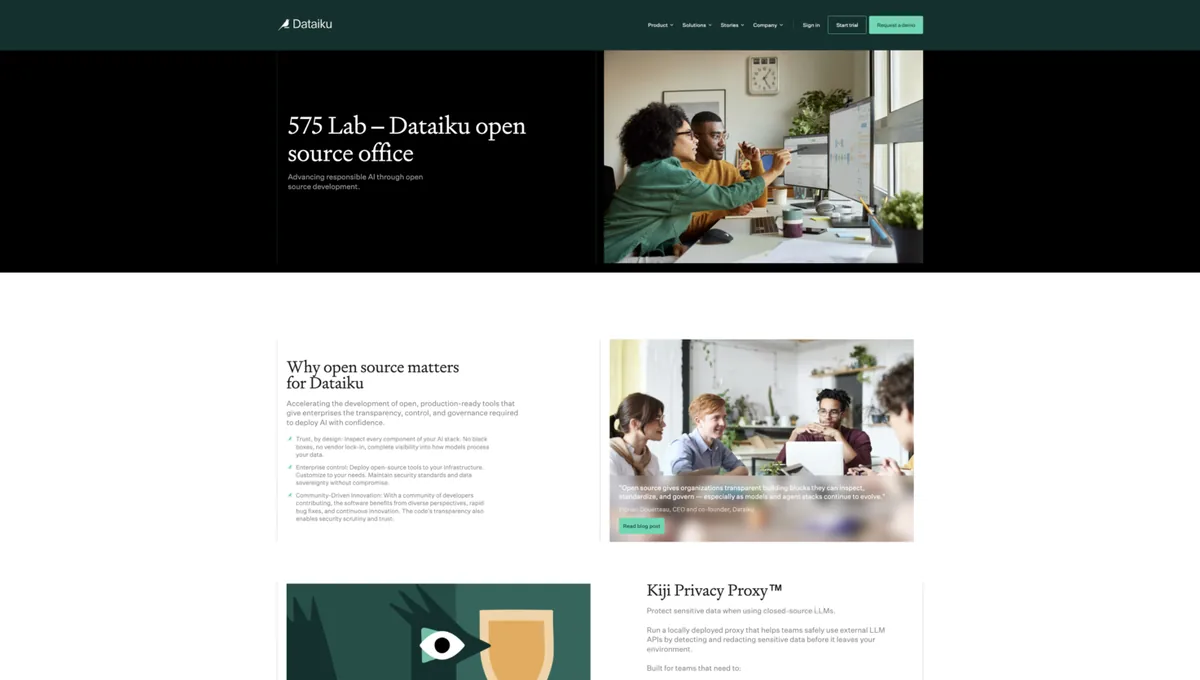
Dataiku's open source office for responsible AI. It builds privacy-first tooling and agent transparency in the open, such as the Kiji Privacy Proxy™: a locally deployed proxy that detects and redacts sensitive data before a prompt leaves your environment for an external LLM API.

Visit 575 Lab
In the guide
575 Lab · Model comparison

LLM Arena

Send one prompt to a closed-source and an open-weight model side by side, and compare the answers along with latency, time to first token, and token counts. You bring your own API keys; they stay in your browser's local storage and go straight to each provider.

Stick to prompts without production data: they still reach both providers (Step 3).

Open the arena
In the guide
The Apache Software Foundation

Responsible AI Initiative

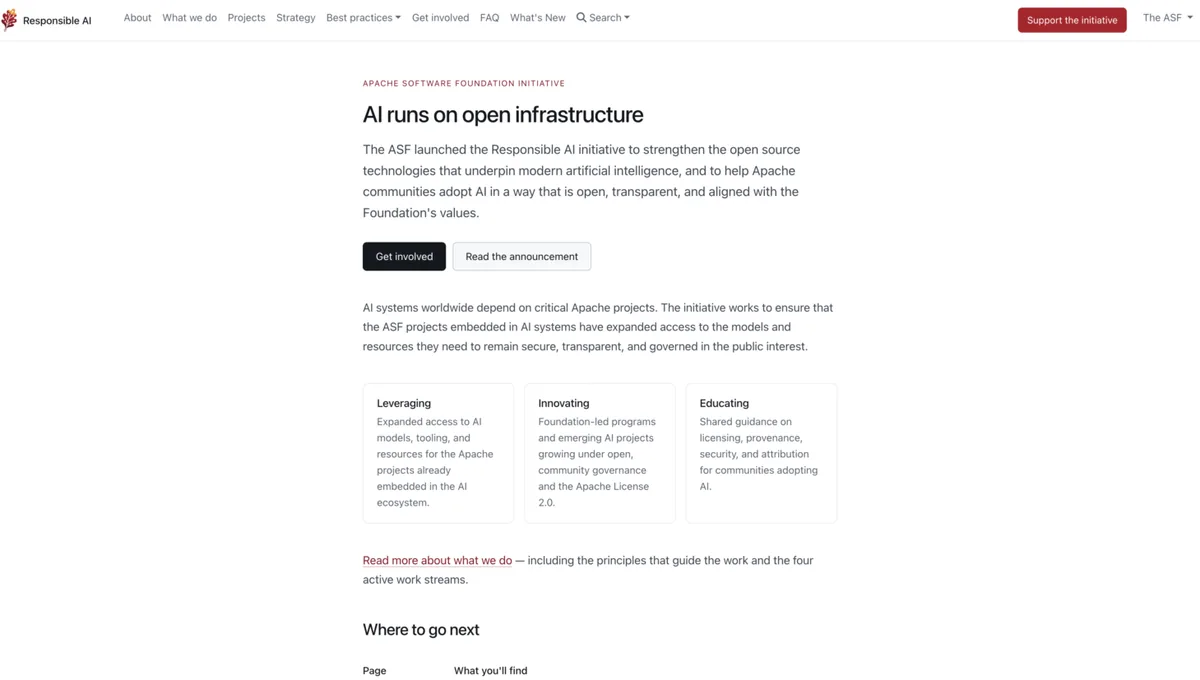
A $10M initiative, launched in April 2026, to keep the open-source infrastructure under modern AI secure, transparent, and governed for the public good. It funds access to AI models and tooling for Apache projects, and publishes shared guidance on licensing, provenance, security, and attribution.

Read about the initiative
In the guide